Most buyers fall in love with a number. It's right there at the top of the listing, big and bold, and it quietly becomes the whole conversation — can we afford that number, can we beat someone else to that number, can we talk the seller down off that number. But the price on the listing is the one cost in a Southwest Florida home purchase that everyone sees coming. It's the costs around it — the ones that don't show up until you're already emotionally invested — that decide whether a home is genuinely affordable or just affordable on paper.
We'd rather you hear this from us early, with a calculator and a cup of coffee, than discover it line by line on a closing disclosure. So here's an honest accounting of what it actually costs to buy a home here in 2026 — and why the real number is almost never the one in the headline.
Closing Costs: The 2-to-5-Percent You Don't Get Back
Closing costs are the fees that turn an accepted offer into a deed with your name on it, and in Florida they tend to run a little richer than the national average. As a buyer, plan on roughly 2 to 5 percent of the purchase price — on a $400,000 home, that's somewhere between $8,000 and $20,000 — covering lender and origination fees, your appraisal, title search and title insurance, recording fees, and the prepaid taxes and insurance your lender collects up front to seed your escrow account.
We've written separately about how all of this rolls into your cash to close, so we won't relitigate it here. The point worth repeating is simple: this money is real, it's due at the table, and it is entirely separate from your down payment. Buyers who budget only for the down payment are the ones who get a nasty surprise three days before closing.
Homeowners Insurance: The Line Item That Rewrote the Math
If one cost has reshaped what's truly affordable in Southwest Florida, it's insurance. The average homeowners premium in Lee County now sits somewhere around $3,600 a year — and "average" is doing a lot of work in that sentence. A 1990s home with an older roof a few hundred feet off a Gulf-access canal can cost dramatically more to insure than a recently built inland home of the same price.
Three things move that number more than anything else: the age and material of the roof, your distance to open water, and the results of a wind mitigation inspection. That last one cuts in your favor — a good wind mit report can meaningfully lower your premium by documenting features the insurer would otherwise assume you don't have.
The single most important habit we build into every purchase: get an actual insurance quote on the specific property while you still have inspection contingencies in place — not after. A premium that comes in $4,000 higher than you assumed is a renegotiation conversation, but only if you learn it in time to have it.
The Property Tax "Reset" Almost Nobody Sees Coming
Lee County's effective property tax rate is actually fairly reasonable — around 0.78 percent, with a median annual bill near $3,100. The trap isn't the rate. It's the reset.
When a home changes hands, the assessed value typically resets to current market value. If the sellers have owned the place for fifteen years, they've been protected by Florida's Save Our Homes cap, and the taxes they've been paying may be a fraction of what you'll pay starting next year. We've seen buyers budget off the seller's $2,400 tax bill and inherit a $6,000 one. Always underwrite the home on what the taxes will be after you buy — and if it'll be your primary residence, file for your Homestead Exemption promptly. It trims your taxable value and, going forward, caps how fast your assessment can climb.
Below is a link to the Lee County Property Appraiser. Here, you can locate the property you are interested in, and use a tool called “Tax Estimator” to find out a more realistic estimate of what you will be paying.
Flood Insurance: Don't Inherit an Assumption
In a great many Southwest Florida neighborhoods, flood insurance isn't a maybe — and even where a lender doesn't strictly require it, carrying it is often the right call. Premiums swing widely depending on the flood zone, the home's elevation, and whether you go through the National Flood Insurance Program or a private carrier.
The mistake we see again and again: buyers assume the seller's flood situation transfers to them. It doesn't, not cleanly. Flood maps get redrawn, and policy pricing depends on you. We pull the flood zone early in every transaction — well before the appraisal — so the number is a known quantity, not a closing-week ambush. (If flood zones genuinely confuse you, we broke them down in plain English in a separate post — that's worth ten minutes of your time.)
HOA and CDD Fees: Two Bills, Not One
Plenty of Southwest Florida communities come with a homeowners association, and a good number of the newer master-planned ones also sit inside a Community Development District. People conflate the two constantly. They are not the same, and both land on your bottom line.
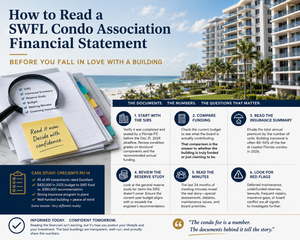
HOA dues fund amenities and shared upkeep, and they range from modest to substantial depending on what the community includes. A CDD assessment — frequently folded right into your annual property tax bill — is something else entirely: it's paying down the bonds that financed the community's roads, drainage, and utilities. A home can look like a bargain next to its neighbors until you notice it carries a CDD line the others don't. Before you're emotionally committed, we get you the real HOA dues, the association's financials, the reserve picture, and any CDD balance, so the monthly number you're comparing is the whole number.
Inspections: A Few Hundred Dollars That Protect Six Figures
Beyond a standard home inspection, Southwest Florida buyers often want several others: a wind mitigation inspection, a four-point inspection (commonly required to insure older homes), a roof assessment, and a WDO — wood-destroying organism, which is the polite term for termites. Homes with pools, docks, or seawalls may each warrant their own look.
It adds up to a few hundred dollars apiece, and it is the highest-return money you'll spend in the entire transaction. Inspections aren't just peace of mind — they're your leverage to renegotiate price, ask for a credit, or walk away clean. And in this market, they're also how you learn your insurance story before you're locked into it.
The Costs That Start the Day You Get the Keys
The purchase ends at closing. The ownership costs don't. Living well in Southwest Florida carries its own running tab worth planning for honestly: cooling bills that crest hard in July and August, irrigation and landscaping, pool service if you've got one, and a genuine maintenance reserve. A reasonable rule of thumb is to set aside about 1 percent of the home's value every year for upkeep. Salt air, sun, and storm season are tough on a house — budgeting for maintenance isn't pessimism, it's just how ownership here actually works.
The Bottom Line
Add it all up and the picture comes into focus: the home that "costs" $400,000 asks meaningfully more of your budget than that number suggests, once insurance, the tax reset, flood coverage, association fees, closing costs, and ongoing upkeep are all on the page. That's not a reason to be discouraged. It's a reason to plan. The buyers who go in with clear eyes are the ones who close with confidence — and who never spend the next three years feeling house-poor in a home they supposedly could afford.
How the Hawley Team Helps
This is exactly the work we do for every buyer, before you ever fall for a listing. We build out your true numbers — the real monthly cost and the real cash-to-close — for the specific neighborhoods and price points you're considering, whether that's Fort Myers, Cape Coral, Estero, the beaches, or anywhere in between. We get insurance quotes on real addresses during your contingency window, pull flood zones early, run down HOA financials and CDD balances, and tell you what the taxes will actually be next year, not what the seller has been paying.
Over the years, that habit has kept our clients out of homes that looked affordable and weren't, and helped them buy with the quiet confidence of knowing every number on the page. If you're thinking about buying in Southwest Florida, reach out before you write an offer — that's the moment this kind of clarity is worth the most.