12 minute read
AT A GLANCE
On June 25, 2026, FinanceBuzz published a viral piece titled "Realtors Predict Home Prices in These 10 Cities Will Crash in the Next 12 Months." Three of the ten cities named are markets we work every day: Cape Coral-Fort Myers (predicted decline above 10%), North Port-Sarasota-Bradenton (8.9% predicted decline), and Naples-Marco Island. The piece blames insurance premiums, hurricane risk, and a surge of inventory. Out-of-state buyers are sending us the link. Local owners are reading it and asking whether they should panic-list. This post is the rebuttal those buyers and owners deserve. What the article gets right, where its framing falls apart locally, and what the Hawley Team is actually seeing on the ground in June 2026, sourced from the same Realtor.com data the article cites and from our own May 2026 submarket reports for Estero, Naples, Bonita Springs, Lehigh Acres, and Cape Coral.
First, What the Article Gets Right
A serious rebuttal acknowledges the parts that are true. Three things in the FinanceBuzz piece are factually correct and worth taking seriously.
1. Inventory has grown. SWFL active inventory in mid-2026 sits well above the 2021 and 2022 lows. Buyers have meaningfully more choice than they did during the pandemic-era frenzy. Our 6/15 Naples and 6/24 Bonita Springs market updates both showed months-of-supply readings that put those submarkets in balanced-to-buyer-friendly territory, not the seller-frenzy territory of 2021. The article is not wrong about inventory.
2. Insurance premiums are higher than they were five years ago. We covered the SWFL insurance landscape in detail in our 6/1 Hurricane Season Insurance and Prep Guide. Florida homeowner premiums have moved sharply since 2022 driven by reinsurance market dynamics, post-storm claims experience, and statewide carrier consolidation. A buyer who skips the insurance quote in their underwriting math is making a real mistake. The article is right to flag this.
3. National forecasts do project price softness in some Florida metros. Realtor.com's 2026 forecast, which the article cites, does include several Florida metros among the 22 of the top 100 expected to see declines this year. We are not going to pretend that number does not exist.
That is where the agreement stops. Everything else in the article is either national-finance-publisher framing imported into local markets where it does not fit, generic advice from quoted realtors who do not work the markets being discussed, or selective citation that hides the structural reasons SWFL is not the 2008 setup the headline implies.
Where the Article's Framing Falls Apart
The word "crash" is doing a lot of work in that headline. Realtor.com's actual forecast for Cape Coral-Fort Myers is a price decline of more than 10% over twelve months. A double-digit single-year decline is meaningful and worth taking seriously. It is not a crash. Crashes are the 2007-to-2011 SWFL experience, where the Lee County median single-family price fell more than 60% from peak to trough and stayed depressed for years. Crashes involve forced sellers, foreclosure waves, distressed inventory, and a credit market freeze. The 2026 setup looks nothing like that, and the article does not say it does. The headline says "crash." The body says "decline." The reader is left with the headline.
The realtors quoted are not, with two exceptions, from the markets they are discussing. The agent quoted on Cape Coral-Fort Myers and Tampa is with a brokerage based in Orlando. The agent quoted on North Port-Sarasota-Bradenton is the president of a St. Louis-based national homebuying company. The agent quoted on Naples-Marco Island works with a real estate photography service. They are not wrong people for a national finance site to quote. They are also not local SWFL practitioners. When a Fort Myers homeowner reads what a "realtor" says about Fort Myers, they reasonably assume the realtor lives and works in Fort Myers. In this article, that is not the case.
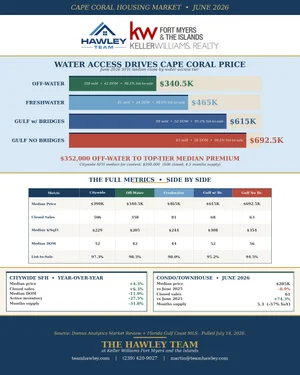
The metro-area framing hides enormous submarket variance. "Cape Coral-Fort Myers" is the official Census MSA that covers all of Lee County. It includes Buckingham, where a one-acre custom build is a different market entirely from a Cape Coral cookie-cutter canal home, which is a different market from a Lehigh Acres starter property, which is a different market from a Fort Myers historic district restoration, which is a different market from a Burnt Store waterfront condo. A 10% MSA-level forecast hides the fact that some submarkets are projected to soften meaningfully and others are projected to be flat or to appreciate. We covered exactly this kind of submarket variance in our 6/10 Estero, 6/15 Naples, 6/17 Cape Coral Canals, 6/23 Lehigh Acres, 6/24 Bonita Springs, and 6/26 Cape Coral vs Fort Myers posts, each of which used the actual Domus Analytics April 2026 single-family data for the specific submarket discussed.
Naples-Marco Island is the most misleading inclusion of the three. Our 6/15 Naples Market Update used May 2026 MLS data for Old Naples, Park Shore, Pelican Bay, and Lely Resort. The high end of the Naples market (Old Naples, Port Royal, Aqualane Shores) continues to clear, even when broader luxury inventory takes longer. The article quotes a real estate photography service agent who says "luxury homeowners are less likely to find much resale demand." That is not what our 2026 Naples luxury closings show. Some price tiers and some specific neighborhoods have absorbed more inventory than others; broad statements about Naples luxury collapse are not supported by the actual 2026 closings.
Insurance: The Real Picture, Not the Doom Frame
The article uses a $200 to $400 per month additional insurance estimate to imply Florida is becoming uninsurable. Two things are missing from that framing.
First, insurance is rising in many states, not just Florida. California wildfire exposure has triggered carrier withdrawal across that state. Louisiana, Texas, Oklahoma, and most of the Atlantic seaboard have seen meaningful premium increases. The article treats Florida insurance as a unique disqualifier. It is not unique. It is part of a national reinsurance reset.
Second, 2024 and 2025 Florida statutory reforms (Senate Bill 2A, the Citizens depopulation program, and reforms to the assignment-of-benefits and one-way attorney fees framework) have already begun to stabilize the Florida homeowner market. New carriers have entered. Existing carriers have resumed writing new business. The trajectory of Florida insurance in 2026 is not the trajectory it was in 2022. The article does not mention any of this.
The practical takeaway for buyers and sellers: insurance is real, insurance is part of the underwriting math, and any responsible SWFL buyer or seller is going to talk to their insurance agent before signing anything. That is the same advice we have given every Hawley Team buyer and seller for years. It is not a reason to call the entire market a crash candidate.
Hurricane Risk: The Honest Version
Hurricanes are a real and recurring risk in SWFL. We do not pretend otherwise. We covered the 2026 hurricane season preparation framework in detail in our 6/1 post.
What the article skips: the post-Ian SWFL inventory is structurally tougher than the pre-Ian inventory. Homes that were not built to current code, that flooded, that were undermined structurally, or that were uneconomic to rebuild have largely been removed from the inventory or rebuilt to better standards. A 2026 Cape Coral canal home that survived Ian and Helene and Milton is, on average, a better-built and better-insured property than it was in 2021. That is not a small thing. The buyers we are working with in 2026 are buying into a market where the structural quality of the inventory has gone up, not down.
The other thing the article skips: demographics. Florida population growth has not stopped. The state added more net residents in 2024 and 2025 than any state other than Texas. SWFL specifically continues to see meaningful net in-migration from the Midwest, the Northeast, and elsewhere in Florida. Demand from real people who want to live here has not disappeared. It has rebalanced from pandemic peak to something more sustainable.
Inventory: Higher Inventory Is Not a Crash
The article cites the inventory surge as a key driver of expected price decline. This is technically correct and worth a closer look.
Inventory is up because:
Construction completed. Builders that started in 2021 and 2022 finished those projects in 2024 and 2025. New construction inventory hit the resale market.
Pandemic buyers re-listed. Some buyers who bought in 2020 or 2021 for non-financial reasons (lifestyle, remote work) have re-listed as employment dynamics shifted.
Older homeowners moved earlier than they planned. Some long-tenured Florida homeowners chose to monetize equity gains rather than ride out another insurance cycle.
Higher inventory does not equal a crash. It equals a buyer-friendlier market with more negotiating leverage, better selection, and longer-than-2021 days-on-market. Our 6/24 Bonita Springs post quantified this directly: April 2026 Bonita Springs SFH closings averaged about 64 days on market versus the 2021 average of roughly 18 days. That is the article's "crash." It is also a market where well-priced, properly-marketed properties continue to close, and where buyers have more time to make a thoughtful decision than they did three years ago.
The Historical Pattern
SWFL has been "about to crash" repeatedly in national-publisher headlines over the last fifteen years.
2015 to 2017: national pieces argued that post-recession SWFL appreciation was a bubble that could not be sustained.
2019: pieces warned of an oversupply driven by builder activity in Cape Coral, Lehigh, and Bonita.
2022 (post-rate shock): national pieces called for a 25% to 40% Florida pullback within twelve months as mortgage rates moved from 3% to 7%.
Late 2022 and 2023 (post-Ian): pieces argued SWFL was structurally uninsurable and uninvestible.
In each of those cycles, national doom predictions outpaced what actually happened locally. Lee County SFH median values are materially higher in 2026 than they were when each of those headlines ran. That does not guarantee the next twelve months will follow the same pattern. It does suggest that national-publisher SWFL doom is a recurring genre with a poor track record.
What Buyers Should Actually Do
If you are reading FinanceBuzz and wondering whether now is a buy moment in SWFL, here is the honest framework.
1. Get clear on the property type you want. Our 6/26 Cape Coral vs Fort Myers post lays out the four buckets we work through with every Lee County buyer: acreage, water, character, or walkable urban. Get the property type right first. The submarket is downstream.
2. Pull the actual carrying-cost math on the candidate property. Mortgage, taxes (city or unincorporated; utility assessment status in Cape Coral), insurance quote from a current Florida-licensed agent, HOA, lawn and pool service. Total monthly cost of ownership is what matters. The headline price is not.
3. Insist on a current insurance quote in writing, not last year's bill. The insurance market has moved. Use a number based on what your specific property quotes today, not what it was last year.
4. If you can buy in a buyer-friendlier market without overextending, do. A buyer who locks in the right property at a discount to the 2022 peak, with a quoted insurance number they can live with, in a financing structure they understand, is the buyer who wins this cycle. The article gets this part right when it quotes one of the realtors saying buyers can negotiate again. That is real. It is also the most useful sentence in the piece.
What Sellers Should Actually Do
If you are reading the article and wondering whether to panic-list, here is the honest framework.
1. Do not panic-list. A national piece predicting a 10% MSA-level decline is not actionable guidance for whether to list your specific property. Whether to list depends on your specific property, your specific timeline, your specific reason for selling, and the specific submarket.
2. Pull your specific submarket data. Our June 2026 series gives you a starting point: 6/10 Estero, 6/15 Naples, 6/17 Cape Coral, 6/23 Lehigh Acres, 6/24 Bonita Springs. Your specific submarket may be softer than the metro average, or stiffer. The metro average will not tell you which.
3. Have the six conversations. Our 6/25 post lays out the six conversations the Hawley Team has with every seller before the listing agreement is signed: pricing strategy, pre-listing inspection, photo and marketing decisions, showing protocol, contract review, and settlement statement review. Sellers who do those six things still close in 2026. Sellers who skip them are the ones who tell the FinanceBuzz reporter their market crashed.
4. Price to the 2026 market, not the 2022 market. This is the single biggest mistake we see. A 2022 list price applied to a 2026 buyer pool produces zero offers, lengthening days on market, and the eventual concessions that turn into the data point that confirms the original doom headline. Sellers who price to the 2026 buyer pool from day one continue to close cleanly.
What the Hawley Team Is Actually Seeing in June 2026
Across the active Hawley Team listings and buyer files in June 2026:
Buyers are showing up, touring, and writing offers. The buyer pool is smaller than 2021 and more deliberate, but it is real.
Well-priced, well-prepared properties are still closing in time frames that look like 2018 and 2019, not 2007 and 2008.
The properties that are sitting are the ones priced to 2022 expectations or marketed without recent professional photos.
Cash buyers continue to write competitive offers, particularly in the Naples luxury tier and in waterfront Cape Coral.
Out-of-state buyer interest from the Midwest and Northeast remains strong.
Insurance underwriting is the most common contingency issue, not financing.
This is a normalizing market, not a crashing one. That is not a brand line. It is what the actual files look like.
How We Can Help
Kim and Martin Hawley work Lee, Collier, and Charlotte county buyers and sellers across every price tier. We pull the submarket data on your specific neighborhood before you list, not after. We get the insurance quote in writing as part of buyer underwriting. We price to the 2026 buyer pool, not the 2022 buyer pool. And when a national publisher tells you the sky is falling, we will tell you the truth about what we are actually seeing in your specific submarket this week.
If you are buying or selling anywhere in Southwest Florida in 2026, send us a note.
Kim and Martin Hawley are Realtors with The Hawley Team at Keller Williams Fort Myers and the Islands.
The Hawley Team at Keller Williams Fort Myers and the Islands
(239) 420-9027 | martin@teamhawley.com | teamhawley.com
Disclosures
This post is a response to the June 25, 2026 FinanceBuzz article "Realtors Predict Home Prices in These 10 Cities Will Crash in the Next 12 Months" and to the Realtor.com 2026 forecast data the article cites. The Hawley Team does not represent that any specific submarket forecast in this post is a guarantee of future market behavior. Market conditions change. Specific property-level decisions should be made with current data on the specific property under consideration.
Submarket data points referenced in this post are sourced from the Hawley Team's previously published June 2026 market update series (6/10 Estero, 6/15 Naples, 6/17 Cape Coral Canals, 6/23 Lehigh Acres, 6/24 Bonita Springs, 6/26 Cape Coral vs Fort Myers) using Domus Analytics and MLS data.
Each Keller Williams office is independently owned and operated. Equal Housing Opportunity.