9 minute read
AT A GLANCE
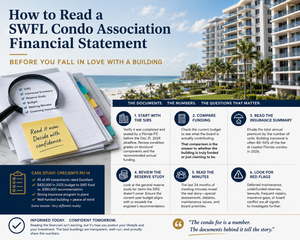
Florida Statute 718.503 gives you the governing documents, the FAQ sheet, the last year-end financial statement, and a governance form. That is the floor, not the read. The documents that actually tell you whether a building is sound are the Structural Integrity Reserve Study, the general reserve study, the current-year board-approved budget, the broker's insurance summary, and twenty-four months of meeting minutes. This post walks through how to read each one, including the two pieces of math that settle most questions: divide the annual insurance premium by unit count to see how much of your fee is building insurance, and divide the total budget by units and by twelve to confirm the published fee reconciles. Creciente's numbers run as the case study throughout, with 45 of 49 structural components rated Excellent, a $420,000 SIRS contribution against a $380,000 recommendation, and a fee that closes to within five dollars of the budget math. The single biggest 2026 red flag is a building that never completed a compliant SIRS by the December 31, 2024 deadline, because lenders are increasingly refusing to finance in those buildings.
Every Florida condo shopper eventually opens a stack of association documents and finds themselves looking at a Structural Integrity Reserve Study, a Marsh McLennan insurance summary, a board-approved budget, twenty-four months of meeting minutes, and a signed seller condominium rider that references documents nobody explained. The stack is dense. It is also the single most important read a Florida condo buyer will do in 2026.
Kim and I have opened these packets on Fort Myers Beach, Sanibel, Bonita Springs, and Naples over the last two years. The patterns are consistent. Certain documents matter more than the fee itself. Certain sentences buried in the meeting minutes tell you more than any listing description ever will. This piece walks through what to actually read, what to look for, and where the traps live.
The Creciente PH-14 post from last Thursday is the working case study behind everything below. If you want to see these principles applied to a specific building's paperwork, that piece is on the site.
What am I actually entitled to see before closing?
Florida Statute 718.503 requires the seller to give a prospective buyer the current governing documents, the frequently asked questions and answers sheet, the most recent year-end financial statement, and a governance form. That is the statutory floor.
The real read requires more. Ask for the Structural Integrity Reserve Study, the general reserve study, the current-year board-approved budget (not just last year's audit), the current insurance summary from the association's broker, and the last twenty-four months of board meeting minutes. Every one of these documents legally belongs to the members. A well-run association will send them without friction. A cagey response to this list is itself a signal.
The document request list
Here is the full request, what each document is for, and what a bad answer looks like.
| Document | What it answers | Warning sign |
|---|---|---|
| Structural Integrity Reserve Study | Is the building structurally sound and funded for it? | Not completed, not sealed by a Florida P.E., or multiple components graded Poor |
| General reserve study | Are the non-structural capital items funded? | Board contribution materially below the engineer's recommendation |
| Current-year board-approved budget | Does the fee reconcile to actual expenses? | Fee well below budget math with no durable offsetting income |
| Broker insurance summary | How much of the fee is building insurance? | Insured value well below current replacement cost |
| 24 months of meeting minutes | What is coming that is not in the numbers yet? | Capital projects discussed with no identified funding source |
| Seller condominium rider | Has a special assessment been levied or discussed? | A "none" answer that the minutes contradict |
What is a SIRS and how do I read it?
The Structural Integrity Reserve Study is the post-Surfside document that changed Florida condo buying. It applies to every condominium three stories and up. The December 31, 2024 statutory deadline required a licensed Florida professional engineer to inspect the building's structural components, grade their condition, project their remaining useful life, and calculate the funding required to replace each one on schedule.
What to look for when you open a SIRS. Confirm it was completed and sealed by a Florida P.E. before the statutory deadline. Read the condition grades on the structural components. Roofs, load-bearing walls, foundations, waterproofing, and fire life safety are the high-consequence items. A building where 40 or more of 45 to 50 graded components come back Excellent is a very different asset than a building where half the components are graded Fair or Poor. Read the funding table next. The study will recommend an annual replacement fund contribution. Then read the current budget to see what the board is actually contributing. That comparison is the answer to whether the building is truly funded for its structural obligations or just claiming to be.
The Creciente SIRS came back with 45 of 49 components rated Excellent, and the 2025 budget puts $420,000 into the SIRS replacement fund against SOCOTEC's $380,000 recommendation. That is what a funded building looks like on paper. Compare that to a SIRS sitting in a condo packet across town that recommends $600,000 a year and shows a $250,000 contribution. Same statute. Very different reality.
How do I know the general reserves are funded?
The SIRS covers structural components. The general reserve study covers the other capital items the association owns. Elevators, pool decks, landscaping capital, corridor renovation, non-structural roofing membranes, and painting are the common ones.
Read the general reserve study the same way you read the SIRS. What did the engineer recommend for annual funding? What is the board actually contributing? Timing matters here. Many Florida associations adopted their 2024 budget in the summer of 2024, before their reserve studies were even delivered. A 2024 budget cannot fund a recommendation that did not exist at adoption. What you want to see is the current-year budget aligning with, or exceeding, the engineer's recommendation now that the studies are in hand.
How do I read the insurance summary?
The insurance summary is the document most buyers never ask for and most buyers should read first. The association's insurance broker (Marsh McLennan is common in SWFL, but there are others) issues a one-page summary showing the coverages, the total insured values, and the annual premium.
Do this math the moment you open it. Take the total annual insurance premium and divide it by the number of units in the association. That number tells you how many dollars per year of building insurance is sitting inside your condo fee. Building insurance is often 40 to 50 percent of the fee at coastal Florida condos in 2026.
Once you know that number, you can compare a condo fee to the alternative of insuring a single-family home yourself in the same zip code and flood zone. Most buyers assume the condo fee is a premium over what they would pay for a house. When you separate out the insurance, the comparison often flips. The Creciente insurance program insures $56.7 million in structural value at a total premium of $1,249,619. That works out to roughly $7,265 per unit per year of building insurance inside the $17,040 fee. A comparable Gulf-front single-family house was writing an insurance check in that same range in July 2026.
How do I verify the fee is not padded?
Every board-approved budget totals to a number. Take that number, divide by the number of units, divide by twelve, and compare to the published monthly fee. They should reconcile within a few dollars. If they do not, something is either subsidized (rental income, laundry income, interest income offsetting the fee) or hidden.
Creciente's 2025 budget totals $2,376,800 in operating expenses plus $565,000 in reserve transfers. Divide $2,941,800 by 172 units and twelve months and you get $1,425 a month. The published fee is $1,420. The math closes to within five dollars. Nothing hidden.
Try that same calculation on the next condo packet you open. When the fee reconciles cleanly to the budget, the association is running clean books. When the fee is materially below the budget math, ask where the offsetting income is coming from and whether it is durable.
How do I read the meeting minutes?
Twenty-four months of minutes is where the leading indicators live. Read them chronologically. What you are looking for:
Discussion of upcoming capital projects that are not yet in the reserve plan. Discussion of a pending insurance renewal that the board expects to come in higher. Any special assessment that was proposed, debated, tabled, or approved. Any litigation the association is party to. Any board turnover or contentious votes. Any vendor contract change that materially affects operating cost.
The minutes are also where you find the human side of the association. A board that is discussing preventive maintenance three years ahead of a scheduled component replacement is a board running the building. A board that is debating cosmetic changes while ignoring an engineer's warning is a board you should factor into your offer price.
What is a special assessment and how do I spot the risk?
A special assessment is a one-time levy on unit owners to fund something reserves do not cover. Sometimes it is a hurricane deductible after a named storm. Sometimes it is a structural project that came in over reserve. Legal settlements and insurance renewals the reserves cannot absorb are two other common sources.
The seller's condominium rider requires disclosure of special assessments levied within the twelve months before the listing, currently in effect, or discussed at a board meeting during that window. Read that rider carefully. A "none" answer combined with clean meeting minutes and a fully funded reserve schedule is what you want. A "none currently levied" answer next to twelve months of minutes discussing a pending capital project is the buyer's warning label.
What questions should I ask the association manager directly?
Once you have read the packet, get on the phone with the property manager and ask five things.
What is the current delinquency rate on assessments across the association? Any collection issue above five percent tells you owners are struggling to pay, which pressures the whole budget. What is the current insured value on the master policy compared to today's replacement cost? Underinsured buildings become special-assessment machines after storms. What is the reserve fund balance today in actual dollars, not the funding rate but the balance? What percentage of the units are owner-occupied versus rental? Lender approval for financing often depends on this ratio. And what is the next scheduled major capital project, and when is it funded to break ground?
Managers who answer these five questions clearly and quickly are managers running a well-run building. Managers who dodge or delay tell you what you need to know.
When should I bring in a licensed professional?
Any purchase above $500,000 in a Florida condo three stories or older should include a real estate attorney's read of the association documents before the inspection period closes. The document review commonly runs $500 to $1,500 depending on the complexity of the packet. Attorneys who work condo transactions regularly will spot legal exposure and disclosure gaps a buyer will not.
For buildings where the SIRS or the general reserve study raises questions, a structural engineer's review is worth the fee. Post-Surfside, this second opinion has moved from luxury to standard practice at coastal high-rises.
What red flags actually justify walking away?
The paperwork is doing its job when it lets you separate normal noise from real risk.
| Normal noise | Real risk |
|---|---|
| A modest special assessment for a storm deductible that has been paid off | A SIRS with multiple structural components graded Poor |
| An insurance premium increase in line with the coastal market | Reserve contributions materially below the engineer's recommendation |
| One contentious board vote in twenty-four months | A pending or anticipated lawsuit disclosed on the rider |
| A manager who occasionally takes a day to return an email | Delinquency rates above ten percent |
| Routine vendor turnover with no cost impact | Minutes referencing capital projects with no funding source |
| A budget line that grew with inflation | A manager who cannot answer the five questions without pulling files for a week |
The single biggest 2026 red flag is a building that never completed a compliant SIRS by the statutory deadline. Every day past the deadline is a day the building is out of statutory compliance, and lenders are increasingly refusing to finance in those buildings.
The paperwork is the whole game
The condo fee is not the number that tells you whether you are buying a well-run building. The paperwork behind the fee is. A $1,420 monthly fee at a building with 45 of 49 structural components rated Excellent, a fully funded SIRS, a Marsh McLennan program insuring the building for $56.7 million, and a math-checks budget is a very different asset than the same $1,420 at a building that skipped the SIRS deadline, is underfunding reserves, and has a special assessment on the July meeting minutes agenda.
Kim and I read this paperwork on every listing we take and every buyer we represent. If you are looking at a SWFL condo right now and want a second set of eyes on the association packet before you write the offer, call Kim at 239-420-9027 or text me at 239-355-4040. Send the packet over and we will read it with you.
Read this next
The SWFL Snowbird Buyer's Fall 2026 Playbook: When to Start, What to Buy, and How Kim and Martin Actually Work With YouThe Hawley Team at Keller Williams Fort Myers and the Islands
(239) 420-9027 | martin@teamhawley.com | teamhawley.com
Disclosures
Building-specific figures in this post reference the Creciente association documents reviewed in connection with the PH-14 listing, including the SOCOTEC Structural Integrity Reserve Study, the 2025 board-approved budget, and the Marsh McLennan insurance summary in effect at the time of review. Association figures change as budgets are adopted, policies renew, and studies are updated. Verify all numbers against the current documents for any building you are considering.
References to Florida Statute 718 and to Structural Integrity Reserve Study requirements reflect our understanding of the law as of August 2026. Statutes and enforcement practices change. Attorney fee ranges are general observations from SWFL transactions and are not quotes.
This post is educational and is not legal, tax, insurance, financial, or engineering advice. It does not substitute for a licensed Florida real estate attorney's review of association documents, a structural engineer's opinion, or a licensed insurance professional's coverage analysis. Buyers should independently review any association's SIRS, reserve funding plan, budget, insurance program, meeting minutes, and assessment history before committing to a condominium purchase.
Each Keller Williams office is independently owned and operated. Equal Housing Opportunity.