13 minute read
AT A GLANCE
Kim and Martin Hawley run buyer files and listing files across Cape Coral, Fort Myers, Bonita Springs, Estero, Lehigh Acres, Naples, Sanibel, and Captiva. The 12 questions in this post are the ones that come up almost every week. Some are obvious (can I offer less than asking, do I need flood insurance). Some are less obvious until we raise them (the true cost of holding a property, a Cape Coral utility assessment, how the November 2026 property tax amendment changes your math). Some are technical (the Wind Mitigation Inspection, layered short-term rental rules). Some are strategic (new construction, hiring local). All 12 are things a well-prepared SWFL buyer should have the answer to before they write an offer.
1. Can I Offer Less Than Asking Price?
Kim's number-one buyer question, so we are answering it first.
Yes. Almost always yes. In 2026 SWFL, the vast majority of accepted offers close below list price. The nuance is not whether you can, but how much less, and how you support the number.
The framework we use with buyers:
How long has it been on the market? A property that has sat for 60+ days is negotiable in a way that a fresh-to-market property is not. Days on market is the market's own commentary on price.
Where does the price sit against recent comparable closes? If comps within a quarter-mile are closing at $270 per square foot and the list price implies $310 per square foot, the seller is asking the buyer pool to pay above market. That gap is your negotiation space.
What is the seller's story? A relocation seller with a job start date has different flexibility than a seller who is not sure they want to sell at all. Your agent can often surface this in the pre-offer conversation with the listing agent.
What are you asking for beyond price? A clean offer at 96% of list can beat a 92%-of-list offer with three contingencies and a seller-paid closing cost request. Price is one lever. Terms are another.
Kim's phrasing to buyers is direct. "Yes, you can offer less. The question is how much less, and what else you are asking for. Let us build the number together." Full stop.
2. What Is My TRUE Monthly Carrying Cost?
This is the question most buyers do not ask, and it is the most consequential one on this list.
The out-of-pocket monthly cost of owning a Florida home is only half the picture. The other half is the opportunity cost of the equity or the down payment you have tied up in the property.
Here is the framework we use to walk buyers through it. On a $500,000 SWFL purchase with $100,000 down at 2026 mortgage rates:
Mortgage P&I: approximately $2,650
Property taxes: approximately $500
Homeowner insurance: approximately $275
HOA or condo fee: approximately $150
Utilities: approximately $275
Maintenance and reserves: approximately $150
Total monthly out-of-pocket: approximately $4,000
Now the part most buyers skip. Your $100,000 down payment is money that is not earning anything in a high-yield savings account. At a conservative 4.5% return, that is $4,500 per year in lost income, or $375 per month.
Real total monthly cost of ownership: approximately $4,375
The number gets more meaningful the more equity you have. As reported in our 6/30 halfway mark recap, one seller couple this year (whom we anonymized as Tom and Linda) had $580,000 in equity tied up in an unsold Cape Coral home. Their out-of-pocket carry was around $2,800 per month. Their opportunity cost of equity at 4.5% was another $2,176 per month. Real total monthly cost of holding the property: $5,021. Over $60,000 a year on an asset that was not selling.
The insight for buyers. Before you write an offer, calculate the real total monthly cost, not the mortgage payment. The real number is what you will feel every month of ownership. And it is what you should use to negotiate on price, not the listed asking.
3. Do I Need Flood Insurance If I Am Not in a Flood Zone?
Short answer: probably yes. Longer answer:
Flood zones in FEMA parlance are defined for lending purposes. If your property sits in Zone AE, VE, or similar high-hazard zones, your lender will require flood insurance. If your property sits in Zone X or a similar low-hazard zone, your lender may not require it.
Not required does not mean not exposed. Ian's storm surge exceeded the mapped 100-year flood elevation in parts of Cape Coral and Fort Myers Beach by two to four feet. Homeowners in Zone X neighborhoods paid tens of thousands of dollars in uninsured water damage. Flood insurance for a Zone X SWFL property is often meaningfully cheaper than for an AE property, sometimes under $700 per year.
Our 6/30 halfway mark recap noted one of our current listings that sits in AE and carries a flood policy at $975 per year. That is a level of protection most SWFL buyers should consider regardless of zone. Pull the quote before you decide. See our 7/1 hurricane prep mistakes post for more on flood-zone assumptions.
4. What Is a Cape Coral Utility Assessment and Should I Worry About It?
This one comes up in almost every Cape Coral transaction. If you are buying in Cape Coral, you need to know the answer.
Cape Coral has been on a decades-long utility expansion program bringing central water, sewer, and irrigation to areas of the city that were originally built on septic and well systems. The expansion is financed through special assessments levied on the properties that benefit. Some Cape Coral properties have already had their utility assessments paid in full by previous owners. Others have outstanding assessments that may be financed and paid over years on the tax bill.
What to do as a buyer.
Ask your agent to confirm the utility assessment status on the specific candidate property. This information is available from the Lee County Tax Collector, the City of Cape Coral, and the title company.
If there is a balance, the amount can range from a few thousand dollars to $20,000 or more depending on the property and the phase of the expansion.
The financing structure is typically a fixed annual payment for a defined number of years, added to the property tax bill.
Negotiate the assessment at contract. Sellers often agree to pay off the balance at closing. Sometimes the buyer takes over the assessment schedule. Either way, get it in writing before you go under contract.
If your monthly carrying cost calculation from FAQ 2 did not include the assessment, redo the math.
We have watched several buyers close on Cape Coral homes and discover the assessment on their first tax bill. Do not be that buyer. Ask the question at showings, not at closing.
5. Gulf Access vs Freshwater vs Off-Water: What Does That Mean for My Price and My Life?
Our 6/17 Cape Coral Canals post walks through this in depth. The short version:
Gulf access. Your canal connects, through a series of navigable waterways, to the Caloosahatchee River and eventually to the Gulf of America. Boaters can take a boat from the backyard to the Gulf. Commands the highest price per square foot in Cape Coral. Subject to a bridge clearance reality check: some routes have fixed bridges that limit sailboat masts and taller vessels.
Freshwater. Your canal is part of the freshwater canal system. Great for kayaking, paddleboarding, and small boats. No Gulf access. Lower price than Gulf access; often better wildlife viewing.
Off-water. Your lot is not on a canal at all. Meaningfully lower price. Meaningfully lower flood exposure. Also meaningfully lower monthly insurance cost. Off-water is often the smart 2026 Cape Coral entry.
The 6/17 post has the bridge clearance detail and the Gulf-access route considerations. If you are buying Cape Coral in 2026, read it before you write an offer on a canal home.
6. How Does the November 2026 Property Tax Amendment Affect My Purchase?
On June 2, 2026, the Florida Legislature passed HJR 1F, placing a property tax constitutional amendment on the November 3, 2026 ballot. If the amendment passes with the required 60% voter approval, the homestead exemption would rise from $50,000 to $150,000 in 2027 and to $250,000 in 2028, applied against the non-school portion of property taxes. State analysis estimates the change would wipe out non-school property taxes for roughly 60% of homesteaded Florida owners.
What this means for a buyer today.
The amendment does not affect your purchase-year property tax bill regardless of when it passes.
If the amendment passes, your 2027 and 2028 tax bills as a homesteaded Florida owner would materially decrease.
The amendment does not apply to school-board portion of your property tax.
The amendment does not apply to non-homesteaded (investment, vacation-home, or corporate-owned) properties. If you are buying as a second home or investment property, the amendment does not benefit you.
Our position, in a sentence: buy on the property fundamentals, not on a referendum that may or may not pass. A property that is the right property at the right price is the right property whether or not the amendment passes. A property that does not work without the amendment does not work with it either. See our 6/30 halfway mark post for full amendment context.
7. Should I Look at New Construction?
Yes, and here is why. In 2026, builders across SWFL are pairing aggressive pricing with unusually large closing-cost and financing incentives. Buyers who write off new construction because they assume it is out of reach are leaving real money on the table.
The math, condensed:
The builder pays 100% of your buyer's-agent commission. Representation costs you zero out of pocket.
The builder typically provides five-figure closing-cost and lender credits, usually contingent on financing through the builder's preferred lender.
The builder is often willing to negotiate on price, upgrades, or incentives, particularly on inventory homes and quick-move-in units.
The single biggest mistake new-construction buyers make is walking into the builder's sales office alone. The builder's onsite salesperson does not work for you. They work for the builder. Bringing your own agent costs you nothing (builder pays), gives you an advocate in the room who has negotiated with that specific builder before, and preserves your negotiating leverage on price, upgrades, and closing costs.
Our 6/30 halfway mark recap detailed one 2026 close where a disabled-veteran buyer walked away with $20,248 in builder closing credits, roughly $20,000 in instant equity, and $1,141 cash back at closing on a brand-new three-bedroom, three-car-garage home. That is the kind of value new construction is offering in 2026.
8. What Is the Assigned Elementary School and How Does School Choice Work?
Lee County assigns elementary schools by home address. If you have a specific elementary school you want your child in, you need to buy inside that school's zone. The Lee County School District website has the zone-lookup tool. Your agent should verify the assigned elementary school on any candidate property before you write an offer.
Middle school and high school are school-choice. Lee County has open enrollment for middle and high school, meaning families can apply to attend a school outside their zone subject to capacity.
Charter schools. Per what SWFL parents consistently tell us, the strongest options in the local school landscape are the charter schools. Multiple charter schools serve the Cape Coral and Fort Myers areas. If a charter school is part of your plan, get on the application list early. Demand is high.
See our 6/26 Cape Coral vs Fort Myers post for the full school landscape framing.
9. What Is a Wind Mitigation Inspection and Why Should I Care?
A Wind Mitigation Inspection (WMI) is a licensed inspection of the wind-resistance features of your home (roof shape, roof-to-wall connections, opening protection, secondary water resistance) that generates the Uniform Mitigation Verification Form (Form OIR-B1-1802). Filed with your insurance carrier, a current WMI can reduce your annual wind premium by 20% to 40%.
On a $6,000 annual wind premium, that is $1,200 to $2,400 per year. Over five years, an inspection that costs $150 to $300 pays for itself many times over.
Two practical notes for buyers:
Ask if the seller has a current WMI on file. Sometimes it transfers with the property. Sometimes you need to order a fresh one.
Order the WMI as part of your inspection package, not after closing. Your insurance quote will be more accurate before you commit.
See our 7/1 hurricane prep mistakes post for the full context.
10. What Is the Deal With SWFL HOAs?
SWFL HOA structures are all over the map. A few things every buyer should understand:
Equity vs non-equity golf clubs. Some communities require a golf membership at purchase (equity). Some make golf optional (non-equity). Some tier memberships. Read the community documents before you write an offer.
Master associations vs sub-associations. Some large SWFL communities have a master HOA plus a village-level or condo-level HOA. You may be paying multiple monthly fees.
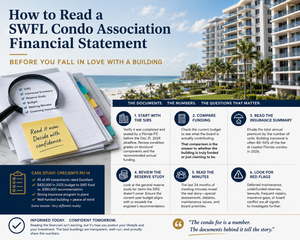
Assessments and reserves. Ask for the reserve study, the current balance of the reserve fund, and any planned or pending special assessments. This matters for condo buildings in particular.
Short-term rental rules. HOAs can tighten city rules on short-term rentals but they cannot loosen them. See FAQ 11.
Transfer fees, application fees, capital contributions. Every HOA charges something at closing beyond the prorated monthly. Get the number in writing before you get to the closing table.
The pattern that hurts buyers most often is assuming the HOA fee they see on the listing is the total monthly HOA cost. In a master-plus-sub-association community, or in a condo with reserves under-funded, the true monthly can be meaningfully higher.
11. Can I Use This Property as a Short-Term Rental?
Three layers of rules, and you need to check all three.
State. Florida short-term rental preemption largely protects a homeowner's right to rent for less than 30 days. There are registration and tax obligations.
City or county. Cape Coral requires an annual $350 short-term rental registration as of January 2026 with active enforcement. Fort Myers city runs a roughly $100 annual permit. Unincorporated Lee County does not currently have a countywide STR framework.
HOA. This is the layer that catches most buyers. Even if state and city allow the rental, your HOA can prohibit it or restrict it. Some gated Cape Coral canal communities require a minimum 90-day or 6-month rental. Some ban STR entirely.
The rule that catches almost every out-of-state investor buyer: the HOA can tighten city rules but never loosen them. State preemption sets a floor. City rules are on top of state. HOA rules are on top of city. The strictest layer wins.
See our 6/22 Vacation Home or Investment Property post for the full framework.
12. Should I Hire a Local Agent, or Use My Out-of-State Agent?
Local, every time. Not because out-of-state agents are bad. Because SWFL is a market with layered rules, submarket-specific pricing patterns, and geographic dynamics that a non-local agent cannot see.
Our 6/30 halfway mark recap detailed the hardest deal of 2026 (a client we anonymized as Sara). Sara had been placed into a country-club property by an out-of-state investment firm that did not understand the local submarket. The property was in an upscale gated enclave that dropped into a neighborhood that would not have qualified for the gate, sat in the SWFL International Airport flight path, and came with a country-club membership obligation that priced it out of half the buyer pool. All of that would have been visible to a local agent before purchase. It was not visible to a national spreadsheet.
If you are buying in SWFL, hire a Realtor who lives here, works here, and drives every submarket on this list every week. The MLS access, the showing coordination, the negotiation with local listing agents, the title company relationship, the insurance agent referrals, the inspector network, the builder-specific negotiation history: all of that is what a local agent brings to your file. It is also what does not appear on a Zillow-driven cold-lead spreadsheet.
Full disclosure: this is the recommendation we would give even if we were not local. It is also the recommendation we give because we are.
How We Can Help
If you are a SWFL buyer with any of these questions (or any question we did not cover), Kim and Martin Hawley are happy to talk it through. The conversation is free. The answers are honest. And if you want the True Cost of Carrying worksheet Martin uses with prospects, send us a note and we will send it your way.
Kim and Martin Hawley are Realtors with The Hawley Team at Keller Williams Fort Myers and the Islands.
The Hawley Team at Keller Williams Fort Myers and the Islands
(239) 420-9027 | martin@teamhawley.com | teamhawley.com
Disclosures
Specific numbers in this post (mortgage payments, tax rates, insurance premiums, HOA fees, carrying cost illustrations, opportunity cost illustrations, builder incentive figures) are illustrative and reflect 2026 SWFL market observations. Actual numbers for any specific property will vary and should be verified with a licensed Florida mortgage lender, title company, insurance agent, and the applicable HOA or master association.
Cape Coral utility assessment status should be verified for any specific property with the City of Cape Coral, the Lee County Tax Collector, and the title company handling the transaction.
Short-term rental rules (state, city, HOA) should be verified against current Florida statute, current municipal ordinance, and current HOA governing documents for any specific property before commitment.
The Florida property tax constitutional amendment (HJR 1F) on the November 3, 2026 ballot requires 60% voter approval to take effect. No outcome is predicted in this post. Voters should refer to the Florida Division of Elections at dos.fl.gov for the authoritative ballot language.
Client references in this post (Tom, Linda, Sara, the disabled-veteran buyer) are drawn from the Hawley Team's mid-year recap and success story archive; all names except the disabled veteran are pseudonyms; the disabled veteran's first name is used with permission with other details simplified.
Each Keller Williams office is independently owned and operated. Equal Housing Opportunity.